


Related Insights
- Commodities 4Q26 - Stay Selectively Constructive05 Oct 2026
- New World Development05 Oct 2026
- USD Rates: Cooler NFP offers fleeting relief05 Oct 2026

The USD’s three-week rally is running out of monetary-policy fuel. Senior Fed officials have pushed back against expectations for a back-to-back hike at the October 28 FOMC meeting. After softer US PCE inflation and nonfarm payrolls data, another concern is emerging. Financial conditions tightened rapidly since the September 16 Fed hike. Since end-June, the rise in the 30-year mortgage rate has overtaken the increase in the 10-year Treasury yield.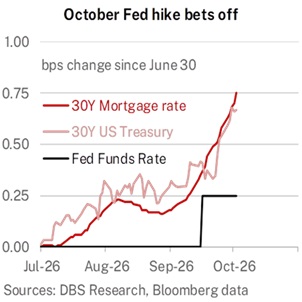
Attention could therefore rotate back towards the more uncomfortable reason long-dated Treasury yields are approaching pre-Global Financial Crisis highs. This distinction matters for the USD.
Higher yields driven by Fed tightening can support the USD. Higher term premia driven by concerns over debt supply, fiscal sustainability, and Treasury-market credibility need not. US Treasury Secretary Scott Bessent’s renewed willingness to intervene alongside Japan to stabilize the JPY without adding selling pressure to Treasuries illustrates that tension.
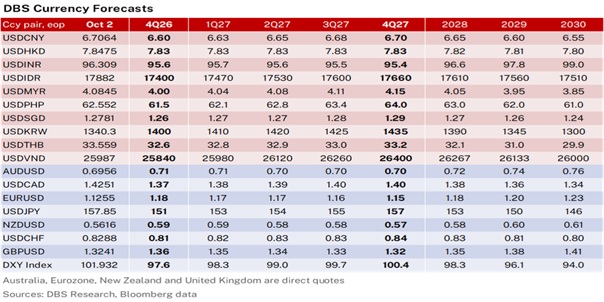
However, USD/JPY has been trapped over the past fortnight, capped by intervention fears around 159-160 and supported around 156.50 by yield differentials favouring the Fed over the Bank of Japan.
The November 3 US midterm elections add another constraint. President Donald Trump and his administration face voter backlash over rising living costs. Tariffs and the Iran conflict have driven up grocery and fuel prices, while households are also confronting higher mortgage and other borrowing rates amid weak real wage growth.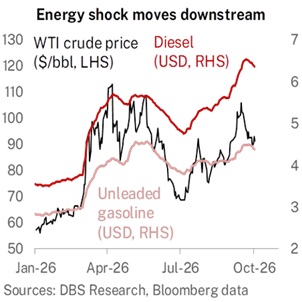
The energy price shock also migrated downstream. WTI crude oil prices have not revisited April’s peak, but energy prices that matter more directly to US households and businesses have not followed crude lower. Gasoline has returned towards its 2026 high, while diesel has surged to new highs amid exceptionally tight distillate supplies.
That divergence helps explain President Trump’s pressure for coordinated G7 action to front-load diesel, alongside its coordinated release of 100 million barrels of emergency crude and fuel stocks. It weakens the argument that US energy self-sufficiency leaves the US economy substantially insulated from global fuel-price shocks.
If Republicans lose control of the House, markets could also reassess the US exceptionalism narrative that supported the USD after its post-Liberation Day sell-off.
Friday’s post-NFP USD sell-off exposed a less uniform FX market than the DXY decline suggested.
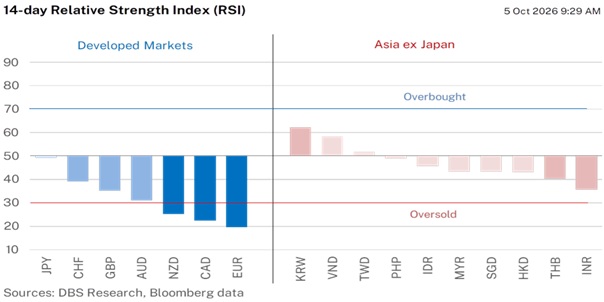
CHF behaved like a haven again, balancing concerns surrounding both the USD and its “anti-USD,” the EUR. Softer US inflation and payrolls coincided with France’s sovereign debt concerns. EUR/CHF declined for a third consecutive week as widening French OAT-Bund spreads outweighed the Swiss National Bank’s decision to buck the global tightening cycle and to temper its CHF intervention rhetoric. USD/CHF’s retreat from its pivotal 0.84 resistance level leaves scope for consolidation around 0.82-0.84.
GBP’s resilience told a different story. It looked more like a repricing of Fed hike expectations after the US payrolls report. Markets continue to distinguish the UK’s difficult fiscal challenge from France’s sovereign-debt stress. Despite elevated gilt yields, investors do not expect the October 28 UK Autumn Budget to reprise the 2022 mini-budget crisis. Fiscal discipline remains anchored by Chancellor John Healey’s pledge to adhere to the fiscal rules and scrutiny by the Office for Budget Responsibility (OBR). The Bank of England’s September 17 decision to pause gilt-sale auctions until April 2027 also reduced a potential source of pressure at the long-end.
EUR/USD’s four-week decline reflected a changing balance of risks on both sides of the Atlantic. First, the Fed’s return to tightening and market expectations of further Fed hikes eclipsed the European Central Bank’s own tightening story. As rising US Treasury yields lifted French OAT yields faster than Germany Bund yields, France’s fiscal problems also eclipsed America’s.
But markets should be careful about extrapolating France’s fiscal difficulties into another euro-area sovereign debt crisis. The widening OAT-Bund spread reflected a repricing of a known French fiscal problem that requires a credible response from Paris. This differs from the 2012 crisis when Greece’s fiscal revelations triggered a “who’s next?” loss of confidence across peripheral Europe. The ECB has stronger institutional firewalls today, including the Transmission Protection Instrument (TPI) to address country-specific stress that threatens monetary policy transmission.
Quote of the Day
“Patience is not simply the ability to wait - it's how we behave while we're waiting.”
Joyce Meyer
Today in history
The Italian lira was devalued by approximately 41% on October 5, 1936, aligning the currency with the US dollar and British pound.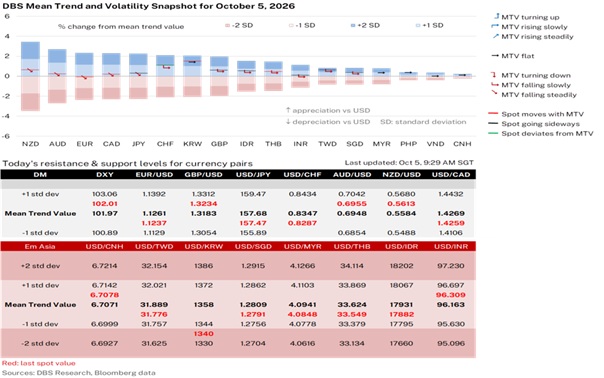

Topic
GENERAL DISCLOSURE/ DISCLAIMER (For Macroeconomics, Currencies, Interest Rates, Digital Assets or Commodities)[1]
The information herein is published by DBS Bank Ltd and/or DBS Bank (Hong Kong) Limited (each and/or collectively, the “Company”). It is based on information obtained from sources believed to be reliable, but the Company does not make any representation or warranty, express or implied, as to its accuracy, completeness, timeliness or correctness for any particular purpose. Opinions expressed are subject to change without notice. This research is prepared for general circulation. Any recommendation contained herein does not have regard to the specific investment objectives, financial situation and the particular needs of any specific addressee. The information herein is published for the information of addressees only and is not to be taken in substitution for the exercise of judgement by addressees, who should obtain separate legal or financial advice. The Company, or any of its related companies or any individuals connected with the group accepts no liability for any direct, special, indirect, consequential, incidental damages or any other loss or damages of any kind arising from any use of the information herein (including any error, omission or misstatement herein, negligent or otherwise) or further communication thereof, even if the Company or any other person has been advised of the possibility thereof. The information herein is not to be construed as an offer or a solicitation of an offer to buy or sell any securities, futures, options or other financial instruments or to provide any investment advice or services. The Company and its associates, their directors, officers and/or employees may have positions or other interests in, and may effect transactions in securities mentioned herein and may also perform or seek to perform broking, investment banking and other banking or financial services for these companies. The information herein is not directed to, or intended for distribution to or use by, any person or entity that is a citizen or resident of or located in any locality, state, country, or other jurisdiction (including but not limited to citizens or residents of the United States of America) where such distribution, publication, availability or use would be contrary to law or regulation. The information is not an offer to sell or the solicitation of an offer to buy any security in any jurisdiction (including but not limited to the United States of America) where such an offer or solicitation would be contrary to law or regulation.
[#for Distribution in Singapore] This report is distributed in Singapore by DBS Bank Ltd (Company Regn. No. 196800306E) which is Exempt Financial Advisers as defined in the Financial Advisers Act and regulated by the Monetary Authority of Singapore. DBS Bank Ltd may distribute reports produced by its respective foreign entities, affiliates or other foreign research houses pursuant to an arrangement under Regulation 32C of the Financial Advisers Regulations. Where the report is distributed in Singapore to a person who is not an Accredited Investor, Expert Investor or an Institutional Investor, DBS Bank Ltd accepts legal responsibility for the contents of the report to such persons only to the extent required by law. Singapore recipients should contact DBS Bank Ltd at 65-6878-8888 for matters arising from, or in connection with the report.
DBS Bank Ltd., 12 Marina Boulevard, Marina Bay Financial Centre Tower 3, Singapore 018982. Tel: 65-6878-8888. Company Registration No. 196800306E.
DBS Bank Ltd., Hong Kong Branch, a company incorporated in Singapore with limited liability. 18th Floor, The Center, 99 Queen’s Road Central, Central, Hong Kong SAR.
DBS Bank (Hong Kong) Limited, a company incorporated in Hong Kong with limited liability. 11th Floor, The Center, 99 Queen’s Road Central, Central, Hong Kong SAR.
[1] This disclaimer may not apply if the applicable assets fall within the definition of 'financial instruments' that are set out in Article 2(1) EU MAR (e.g. financial instruments that are traded on a regulated market, MTF or OTF, etc.). Section C of Annex I of MiFID2 specifies these 'financial instruments'.
Related Insights
- Commodities 4Q26 - Stay Selectively Constructive05 Oct 2026
- New World Development05 Oct 2026
- USD Rates: Cooler NFP offers fleeting relief05 Oct 2026
Related Insights
- Commodities 4Q26 - Stay Selectively Constructive05 Oct 2026
- New World Development05 Oct 2026
- USD Rates: Cooler NFP offers fleeting relief05 Oct 2026