

- PU volumes will continue to rise as hyperscale and enterprise AI buildouts expand, with AI platforms becoming increasingly CPU-intensive.
- As GPU deployments scale, CPU demand should rise in tandem, with larger AI clusters requiring greater orchestration, data movement and system-level coordination to sustain accelerator utilisation.
- Beside the common industry leaders, the providers of picks-and-shovels are also benefiting from this secular trend as the assemblers of AI servers and data-centre systems.
- The AI trade is broadening beyond chipmakers, with hardware OEMs being re-rated as essential enablers of the next phase of AI infrastructure buildout.
Related Insights
- Research Library24 Jul 2026
- Malaysia: Solid fundamentals anchor financial market confidence 24 Jul 2026
- FX Tactical Ideas: Event Risks Ahead for USD24 Jul 2026
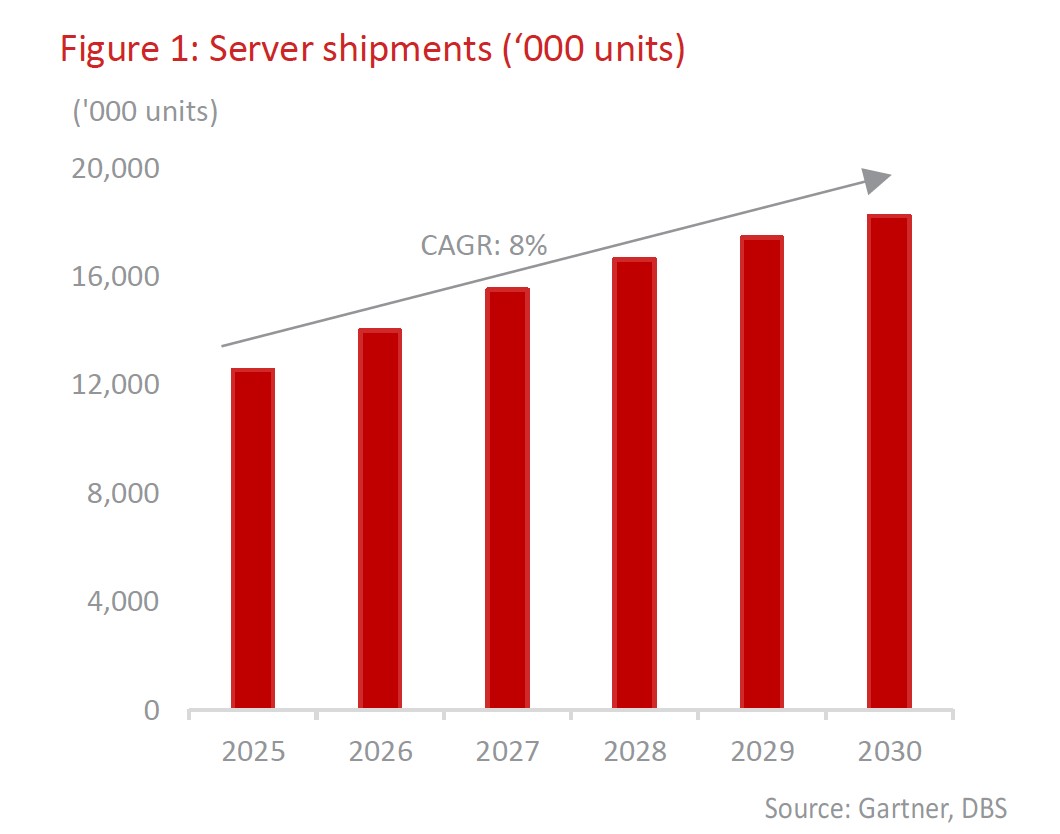
Server CPU demand remains supported by AI-led data-centre expansion. Gartner projects server shipments to grow at an 8% CAGR, from 12.5m units in 2025 to 18.2m by 2030, supporting higher CPU volumes as hyperscale and enterprise buildouts continue. While accelerators remain the main growth driver, newer AI platforms are becoming more CPU-intensive, with GPU-to-CPU ratios moving closer to 2:1 and potentially reaching over time to support agentic AI workloads and complex inference. Intel and AMD remain as key CPU players, while NVIDIA’s CPU presence is nascent but strategically important.
CPU demand rises with AI complexity. While GPUs remain the main accelerators for AI training and inference, CPUs continue to play a critical role in the overall server and data-centre stack, managing orchestration, workload scheduling, data movement, storage, networking, security and general-purpose computing. As GPU deployments scale, demand for CPUs also rises as AI clusters require stronger system-level coordination to keep GPUs efficiently supplied with data and to manage increasingly complex distributed and inference-heavy workloads.
AI servers are becoming more CPU-intensive. Current AI server architectures commonly use around a 4:1 GPU-to-CPU ratio, while some operate on a 8:2 ratio. However, as AI inference and agentic workloads increasingly require larger CPU deployments alongside accelerators, newer rack-scale systems are moving toward higher CPU intensity. NVIDIA’s Blackwell and Vera Rubin platforms are based on 2:1 GPU-to-CPU ratio, while AMD has noted that AI deployments are shifting closer to 1:1 CPU-to-GPU ratios versus historical 1:4 to 1:8 configurations. This suggests that CPU demand could rise structurally alongside GPU demand, benefiting AMD through its EPYC server CPU franchise and NVIDIA through its Grace CPUs, integrated into its AI platforms.
The AI hardware value chain is broadening beyond GPUs. Beyond Nvidia, AMD and Intel, “AI picks-and-shovels” names such as Dell, Lenovo and HP are also gaining investor attention as they assemble and integrate AI servers, GPU clusters, AI PCs and data-centre systems. Recent results from Lenovo, Dell and HP beat expectations, supported by stronger AI hardware demand. Dell and Lenovo are benefiting from robust AI server orders, GPU cluster buildouts and enterprise data-centre spending, while HP and Lenovo are also supported by AI PCs and the Windows 11 refresh cycle. Overall, the market is re-rating these hardware OEMs as key enablers of AI infrastructure buildout, despite not producing the core GPUs themselves.
Download the PDF to read the full report which includes coverage on Credit, FX, Rates, and Thematics.
Topic
The information published by DBS Bank Ltd. (company registration no.: 196800306E) (“DBS”) is for information only. It is based on information or opinions obtained from sources believed to be reliable (but which have not been independently verified by DBS, its related companies and affiliates (“DBS Group”)) and to the maximum extent permitted by law, DBS Group does not make any representation or warranty (express or implied) as to its accuracy, completeness, timeliness or correctness for any particular purpose. Opinions and estimates are subject to change without notice. The publication and distribution of the information does not constitute nor does it imply any form of endorsement by DBS Group of any person, entity, services or products described or appearing in the information. Any past performance, projection, forecast or simulation of results is not necessarily indicative of the future or likely performance of any investment or securities. Foreign exchange transactions involve risks. You should note that fluctuations in foreign exchange rates may result in losses. You may wish to seek your own independent financial, tax, or legal advice or make such independent investigations as you consider necessary or appropriate.
The information published is not and does not constitute or form part of any offer, recommendation, invitation or solicitation to subscribe to or to enter into any transaction; nor is it calculated to invite, nor does it permit the making of offers to the public to subscribe to or enter into any transaction in any jurisdiction or country in which such offer, recommendation, invitation or solicitation is not authorised or to any person to whom it is unlawful to make such offer, recommendation, invitation or solicitation or where such offer, recommendation, invitation or solicitation would be contrary to law or regulation or which would subject DBS Group to any registration requirement within such jurisdiction or country, and should not be viewed as such. Without prejudice to the generality of the foregoing, the information, services or products described or appearing in the information are not specifically intended for or specifically targeted at the public in any specific jurisdiction.
The information is the property of DBS and is protected by applicable intellectual property laws. No reproduction, transmission, sale, distribution, publication, broadcast, circulation, modification, dissemination, or commercial exploitation such information in any manner (including electronic, print or other media now known or hereafter developed) is permitted.
DBS Group and its respective directors, officers and/or employees may have positions or other interests in, and may effect transactions in securities mentioned and may also perform or seek to perform broking, investment banking and other banking or financial services to any persons or entities mentioned.
To the maximum extent permitted by law, DBS Group accepts no liability for any losses or damages (including direct, special, indirect, consequential, incidental or loss of profits) of any kind arising from or in connection with any reliance and/or use of the information (including any error, omission or misstatement, negligent or otherwise) or further communication, even if DBS Group has been advised of the possibility thereof.
The information is not intended for distribution to, or use by, any person or entity in any jurisdiction or country where such distribution or use would be contrary to law or regulation. The information is distributed (a) in Singapore, by DBS Bank Ltd.; (b) in China, by DBS Bank (China) Ltd; (c) in Hong Kong, by DBS Bank (Hong Kong) Limited; (d) in Taiwan, by DBS Bank (Taiwan) Ltd; (e) in Indonesia, by PT DBS Indonesia; and (f) in India, by DBS Bank Ltd, Mumbai Branch.
Related Insights
- Research Library24 Jul 2026
- Malaysia: Solid fundamentals anchor financial market confidence 24 Jul 2026
- FX Tactical Ideas: Event Risks Ahead for USD24 Jul 2026
Related Insights
- Research Library24 Jul 2026
- Malaysia: Solid fundamentals anchor financial market confidence 24 Jul 2026
- FX Tactical Ideas: Event Risks Ahead for USD24 Jul 2026