

- With spreads historically tight, return now comes from carry rather than spread compression, and hence our second-quarter call to stay defensive coupon-clipping with higher-quality credit
- HY credit demands getting sector selection right. With tight historical spreads, the extra yield poorly compensates for higher dispersion and default risk
- Caution on duration extension is warranted. Recent bear-flattening means 2-3Y bucket offers competitive carry with less rate sensitivity
- Caution on duration extension is warranted. Recent bear-flattening means 2-3Y bucket offers competit
- Liquid+ offers a cash alternative and a hedge against growth risks, earning quality carry at the front-end while returning c.21% since 2022 and minimising drawdowns to c.1.5%
Related Insights
- Research Library24 Jul 2026
- Malaysia: Solid fundamentals anchor financial market confidence 24 Jul 2026
- FX Tactical Ideas: Event Risks Ahead for USD24 Jul 2026

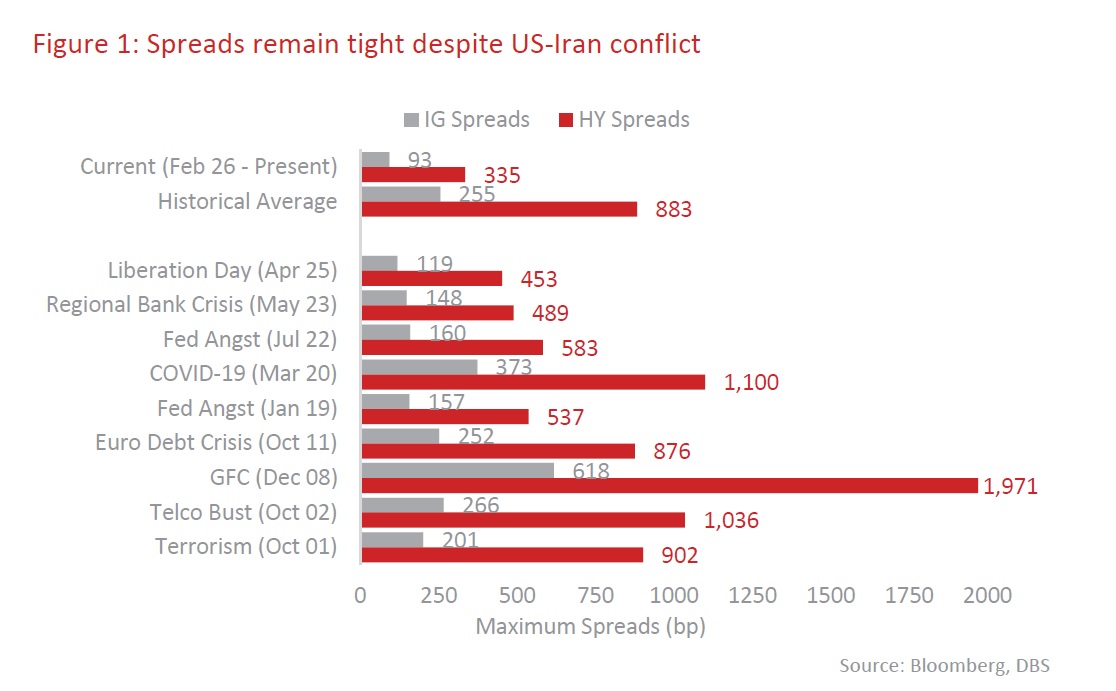
Navigating a credit conundrum. At the start of 2Q26, we moved from an overweight to a neutral stance on fixed income, weighing two considerations. Yields were attractive, and with steady growth and resilient corporate earnings, there was little reason to sell. At the same time, spreads were tight, leaving little reason to add. The natural question was whether the US-Iran conflict ought to have broken this stalemate and forced a more decisive move. Despite a confrontation severe enough to trigger a historic oil shock, investment-grade (IG) spreads held at c.93 bps, roughly a third of their c.255 bps historical crisis average, while high-yield (HY) spreads stayed near c.335 bps against a c.883 bps crisis norm. A crisis of this significance did not inflict the kind of damage that would have justified shedding credit exposure, even as investors remain undercompensated for credit risk by historical standards. Against this backdrop, the call not to trade around the conflict, but to stay anchored to our strategic allocation and favour higher-quality fixed income, should have allowed investors to benefit from steady coupon clipping with some defensiveness amid the uncertainty. Indeed, with IG yields at c.4.6%, coupon income has contributed more than twice as much to total returns YTD as spread compression.
Yet a preference for higher quality invites an obvious challenge. With HY offering a marginally higher yield of c.6.8%, and capturing more returns from spread compression than their IG counterparts, why not reach further down the quality ladder for the higher carry? The answer lies in how that spread compression plays out. Whereas IG spreads tightened across all sectors, all moving within a band of c.10 bps YTD, HY's outcomes saw wider dispersion, spanning close to 200 bps, from a tightening of c.103 bps in energy to widening of c.90 bps in communications and c.77 bps in technology. The HY “advantage” was therefore more a bet on getting sector selection right, with a heavier penalty for getting it wrong. With spreads now historically tight across most of the market, that compression tailwind is largely spent, leaving a much lower margin for error in HY.
Download the PDF to read the full report which includes coverage on Credit, FX, Rates, and Thematics.
Topic
The information published by DBS Bank Ltd. (company registration no.: 196800306E) (“DBS”) is for information only. It is based on information or opinions obtained from sources believed to be reliable (but which have not been independently verified by DBS, its related companies and affiliates (“DBS Group”)) and to the maximum extent permitted by law, DBS Group does not make any representation or warranty (express or implied) as to its accuracy, completeness, timeliness or correctness for any particular purpose. Opinions and estimates are subject to change without notice. The publication and distribution of the information does not constitute nor does it imply any form of endorsement by DBS Group of any person, entity, services or products described or appearing in the information. Any past performance, projection, forecast or simulation of results is not necessarily indicative of the future or likely performance of any investment or securities. Foreign exchange transactions involve risks. You should note that fluctuations in foreign exchange rates may result in losses. You may wish to seek your own independent financial, tax, or legal advice or make such independent investigations as you consider necessary or appropriate.
The information published is not and does not constitute or form part of any offer, recommendation, invitation or solicitation to subscribe to or to enter into any transaction; nor is it calculated to invite, nor does it permit the making of offers to the public to subscribe to or enter into any transaction in any jurisdiction or country in which such offer, recommendation, invitation or solicitation is not authorised or to any person to whom it is unlawful to make such offer, recommendation, invitation or solicitation or where such offer, recommendation, invitation or solicitation would be contrary to law or regulation or which would subject DBS Group to any registration requirement within such jurisdiction or country, and should not be viewed as such. Without prejudice to the generality of the foregoing, the information, services or products described or appearing in the information are not specifically intended for or specifically targeted at the public in any specific jurisdiction.
The information is the property of DBS and is protected by applicable intellectual property laws. No reproduction, transmission, sale, distribution, publication, broadcast, circulation, modification, dissemination, or commercial exploitation such information in any manner (including electronic, print or other media now known or hereafter developed) is permitted.
DBS Group and its respective directors, officers and/or employees may have positions or other interests in, and may effect transactions in securities mentioned and may also perform or seek to perform broking, investment banking and other banking or financial services to any persons or entities mentioned.
To the maximum extent permitted by law, DBS Group accepts no liability for any losses or damages (including direct, special, indirect, consequential, incidental or loss of profits) of any kind arising from or in connection with any reliance and/or use of the information (including any error, omission or misstatement, negligent or otherwise) or further communication, even if DBS Group has been advised of the possibility thereof.
The information is not intended for distribution to, or use by, any person or entity in any jurisdiction or country where such distribution or use would be contrary to law or regulation. The information is distributed (a) in Singapore, by DBS Bank Ltd.; (b) in China, by DBS Bank (China) Ltd; (c) in Hong Kong, by DBS Bank (Hong Kong) Limited; (d) in Taiwan, by DBS Bank (Taiwan) Ltd; (e) in Indonesia, by PT DBS Indonesia; and (f) in India, by DBS Bank Ltd, Mumbai Branch.
Related Insights
- Research Library24 Jul 2026
- Malaysia: Solid fundamentals anchor financial market confidence 24 Jul 2026
- FX Tactical Ideas: Event Risks Ahead for USD24 Jul 2026
Related Insights
- Research Library24 Jul 2026
- Malaysia: Solid fundamentals anchor financial market confidence 24 Jul 2026
- FX Tactical Ideas: Event Risks Ahead for USD24 Jul 2026