

- Protracted US-Iran conflict is keeping energy exports constrained, shipping costs elevated, and oil prices higher for longer
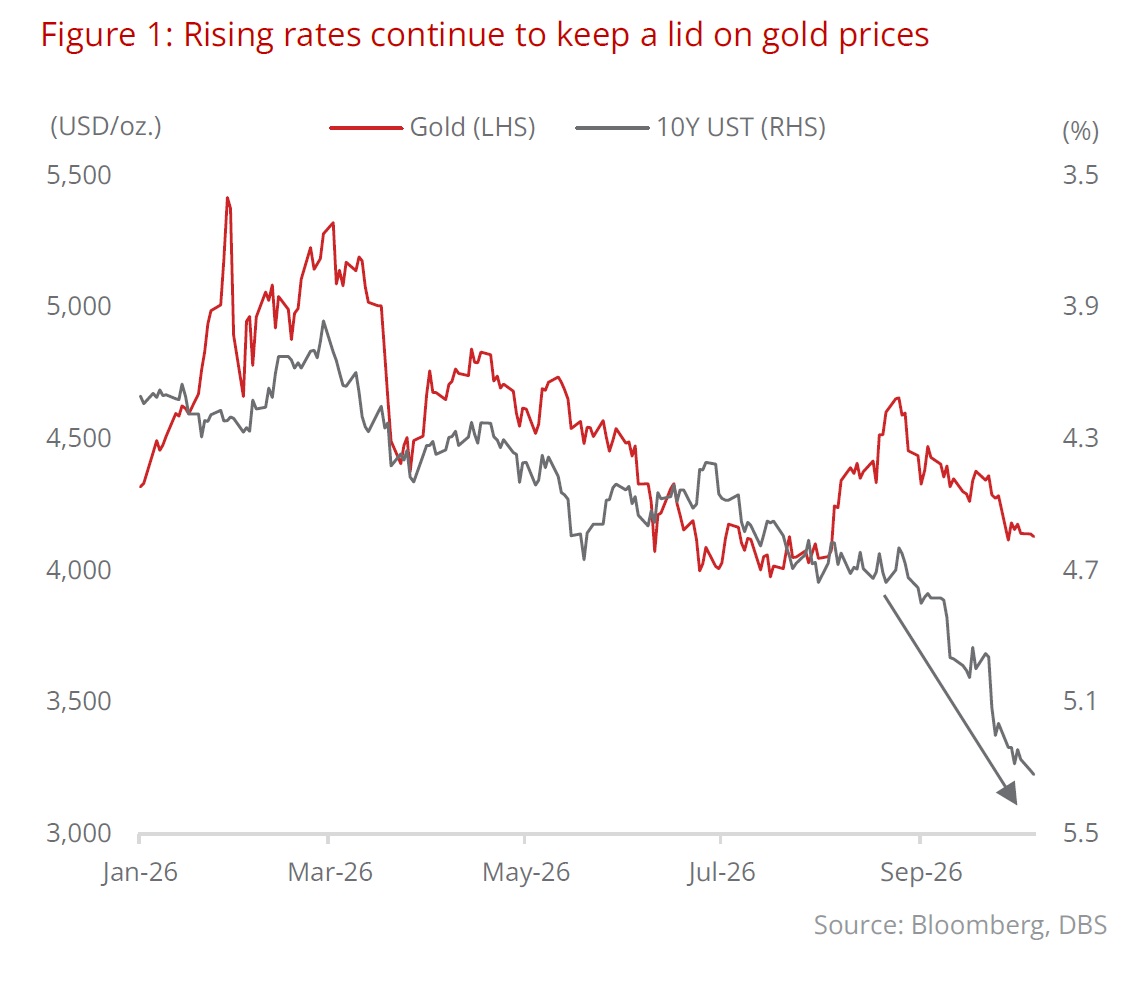
- Higher energy prices have revived inflation risks, lifted treasury yields, and pressured gold from August highs
- However, gold’s sensitivity to rising real yields has halved since 2022, supported by stronger structural demand and shifting macroeconomic conditions worldwide
- Central bank reserve diversification, persistent fiscal deficits, and rising sovereign debt continue to reinforce gold’s long-term narrative
- Overall stance remains constructive; but we recalibrate our quarterly target prices lower on rising yields
Related insights

US-Iran disruption is looking increasingly structural. The probability of a protracted US-Iran conflict has increased substantially. The MOU between the two countries broke down in July, and tensions re-escalated in August and September. Consequently, traffic through the Strait of Hormuz (SOH) has once again ground to a halt. Since then, any attempt at diplomacy has proven ineffective. In particular, the US and Iran seem to have reached an impasse on matters pertaining to nuclear weapons. Energy markets have, in turn, shifted to reflect these developments: Brent has rebounded from its July lows and is now hovering around the USD100/bbl mark. The region is actively re-routing some of its energy exports via the Gulf of Oman and Bab el-Mandeb, but aggregate volumes remain below pre-war levels while costs of shipping (including transport fees, insurance, and ship-to-ship transfers) continue to stay markedly elevated. As such, while these re-routing measures may help to partially alleviate the Hormuz disruption, we believe higher-for-longer energy prices are still firmly in play.
What does this mean for rates? The consequence of higher-for-longer energy prices is, obviously, that inflation risk is once again skewed to the upside, which has led markets to price in more rate hikes. Market consensus on US Fed policy has swung wildly this year. Expectations were broadly for the Fed to continue cutting rates at the start of the year, but the advent of the US-Iran conflict (and its subsequent re-escalations) turned them decisively more hawkish. Consequently, the Fed raised policy rates by 25 bps for the first time in over three years at its September FOMC meeting. As of 6 Oct, markets are pricing another hike by December this year (after the milestone September hike) and an over 40% chance of one more in January next year. As a result of this shift in the rates outlook, government bond yields have moved sharply higher. The 10-year US treasury yield, for example, has risen past the 5.3% handle, the highest level in 24 years. Accordingly, gold fell from its late August peak of USD4,657/oz. to USD4,128/oz. as of 6 Oct.
Download the PDF to read the full report which includes coverage on Credit, FX, Rates, and Thematics.
Topic
The information published by DBS Bank Ltd. (company registration no.: 196800306E) (“DBS”) is for information only. It is based on information or opinions obtained from sources believed to be reliable (but which have not been independently verified by DBS, its related companies and affiliates (“DBS Group”)) and to the maximum extent permitted by law, DBS Group does not make any representation or warranty (express or implied) as to its accuracy, completeness, timeliness or correctness for any particular purpose. Opinions and estimates are subject to change without notice. The publication and distribution of the information does not constitute nor does it imply any form of endorsement by DBS Group of any person, entity, services or products described or appearing in the information. Any past performance, projection, forecast or simulation of results is not necessarily indicative of the future or likely performance of any investment or securities. Foreign exchange transactions involve risks. You should note that fluctuations in foreign exchange rates may result in losses. You may wish to seek your own independent financial, tax, or legal advice or make such independent investigations as you consider necessary or appropriate.
The information published is not and does not constitute or form part of any offer, recommendation, invitation or solicitation to subscribe to or to enter into any transaction; nor is it calculated to invite, nor does it permit the making of offers to the public to subscribe to or enter into any transaction in any jurisdiction or country in which such offer, recommendation, invitation or solicitation is not authorised or to any person to whom it is unlawful to make such offer, recommendation, invitation or solicitation or where such offer, recommendation, invitation or solicitation would be contrary to law or regulation or which would subject DBS Group to any registration requirement within such jurisdiction or country, and should not be viewed as such. Without prejudice to the generality of the foregoing, the information, services or products described or appearing in the information are not specifically intended for or specifically targeted at the public in any specific jurisdiction.
The information is the property of DBS and is protected by applicable intellectual property laws. No reproduction, transmission, sale, distribution, publication, broadcast, circulation, modification, dissemination, or commercial exploitation such information in any manner (including electronic, print or other media now known or hereafter developed) is permitted.
DBS Group and its respective directors, officers and/or employees may have positions or other interests in, and may effect transactions in securities mentioned and may also perform or seek to perform broking, investment banking and other banking or financial services to any persons or entities mentioned.
To the maximum extent permitted by law, DBS Group accepts no liability for any losses or damages (including direct, special, indirect, consequential, incidental or loss of profits) of any kind arising from or in connection with any reliance and/or use of the information (including any error, omission or misstatement, negligent or otherwise) or further communication, even if DBS Group has been advised of the possibility thereof.
The information is not intended for distribution to, or use by, any person or entity in any jurisdiction or country where such distribution or use would be contrary to law or regulation. The information is distributed (a) in Singapore, by DBS Bank Ltd.; (b) in China, by DBS Bank (China) Ltd; (c) in Hong Kong, by DBS Bank (Hong Kong) Limited; (d) in Taiwan, by DBS Bank (Taiwan) Ltd; (e) in Indonesia, by PT DBS Indonesia; and (f) in India, by DBS Bank Ltd, Mumbai Branch.