

- Technology is increasingly acting as the primary sales and margin driver
- Portfolio retrenchment of QSR chains funds high-return digital reinvestment; digital marketing and standardisation also drive profitable traffic
- Casual dining operators found niche in target marketing and menu refinement to strengthen repeat visits
- unlock incremental occasions, such as KFC's KCOFFEE Cafe and Luckin's Calamansi Americano
Related insights
Technology as primary growth architecture. The global quick-service restaurant (QSR) sector is demonstrating structural resilience, underpinned by a permanent shift towards technology-enabled value creation. Unlike prior cycles, major QSR chains have now embedded digital efficiency into their core DNA, with technology evolving from a support function into the primary driver of sales performance and margin protection. The proliferation of AI-powered personalisation, instant e-commerce, and even drone deliveries etc. has opened high-frequency revenue channels with millennials and working professionals, while gradually reducing in-store labour friction and order-accuracy costs.
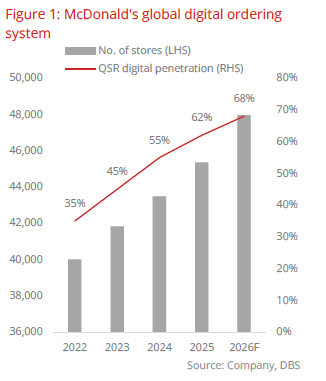
Digital ordering platforms are no longer ancillary sales channels; they are central to performance enhancement through data-driven upselling and dynamic menu management. Beverage innovation (e.g., KFC’s KCOFFEE) has also emerged as an increasingly important growth pillar, driving incremental standalone visits and expanding beyond their traditional role as add-ons. This digital infrastructure is enabling operators to pursue proactive unit expansion in the medium-term, with McDonald’s targeting to reach c.50,000 stores globally by 2028, and Yum’s KFC seeing a 20,000-unit longer term opportunity across India, Southeast Asia, West Africa, and Brazil. Overall, QSR continues to command the largest c.45% revenue share and fastest growth trajectory across the fast-food market, as technology enables operators to scale without proportional cost inflation.
Strategic capital-light format innovation. Against a backdrop of digital-led growth, McDonald’s has adopted a more measured expansion strategy, prioritising digital and operational readiness over near-term store growth. Starbucks’ USD1bn restructuring program also reflects a strategic redeployment of capital into digital infrastructure, employee training, and store technology. Concurrently, Yum China is accelerating KFC’s KCOFFEE Café and KPRO light-meal formats, alongside Pizza Hut’s Burger Bar, to target specific consumption occasions while keeping capital intensity minimal. By introducing tech-enabled formats, QSR contains fixed costs while maintains top-line momentum.
Digital marketing and operational standardisation. The recovery narrative across casual and fast-casual dining further validates technology’s role in demand generation, supporting growth without promotional dependency. Chili’s menu cut by >25% to refocus on core items while leveraging TikTok marketing to position itself as a superior fast-food chain has proven successful in driving traffic recovery. Cheesecake Factory, BJ’s, Chipotle, Cava, Shake Shack, and Wingstop have all posted decent recoveries, supported by robust digital ordering infrastructure that insulates them from the traffic volatility plaguing traditional drive-thru models. On the operational side, McDonald’s announced a global retraining initiative, leveraging digital training platforms to resolve the execution inconsistencies. In this environment, technology functions not merely act as cost containers, but as the essential frameworks through which operators convert traffic into profitable, repeatable transactions.
Topic
The information published by DBS Bank Ltd. (company registration no.: 196800306E) (“DBS”) is for information only. It is based on information or opinions obtained from sources believed to be reliable (but which have not been independently verified by DBS, its related companies and affiliates (“DBS Group”)) and to the maximum extent permitted by law, DBS Group does not make any representation or warranty (express or implied) as to its accuracy, completeness, timeliness or correctness for any particular purpose. Opinions and estimates are subject to change without notice. The publication and distribution of the information does not constitute nor does it imply any form of endorsement by DBS Group of any person, entity, services or products described or appearing in the information. Any past performance, projection, forecast or simulation of results is not necessarily indicative of the future or likely performance of any investment or securities. Foreign exchange transactions involve risks. You should note that fluctuations in foreign exchange rates may result in losses. You may wish to seek your own independent financial, tax, or legal advice or make such independent investigations as you consider necessary or appropriate.
The information published is not and does not constitute or form part of any offer, recommendation, invitation or solicitation to subscribe to or to enter into any transaction; nor is it calculated to invite, nor does it permit the making of offers to the public to subscribe to or enter into any transaction in any jurisdiction or country in which such offer, recommendation, invitation or solicitation is not authorised or to any person to whom it is unlawful to make such offer, recommendation, invitation or solicitation or where such offer, recommendation, invitation or solicitation would be contrary to law or regulation or which would subject DBS Group to any registration requirement within such jurisdiction or country, and should not be viewed as such. Without prejudice to the generality of the foregoing, the information, services or products described or appearing in the information are not specifically intended for or specifically targeted at the public in any specific jurisdiction.
The information is the property of DBS and is protected by applicable intellectual property laws. No reproduction, transmission, sale, distribution, publication, broadcast, circulation, modification, dissemination, or commercial exploitation such information in any manner (including electronic, print or other media now known or hereafter developed) is permitted.
DBS Group and its respective directors, officers and/or employees may have positions or other interests in, and may effect transactions in securities mentioned and may also perform or seek to perform broking, investment banking and other banking or financial services to any persons or entities mentioned.
To the maximum extent permitted by law, DBS Group accepts no liability for any losses or damages (including direct, special, indirect, consequential, incidental or loss of profits) of any kind arising from or in connection with any reliance and/or use of the information (including any error, omission or misstatement, negligent or otherwise) or further communication, even if DBS Group has been advised of the possibility thereof.
The information is not intended for distribution to, or use by, any person or entity in any jurisdiction or country where such distribution or use would be contrary to law or regulation. The information is distributed (a) in Singapore, by DBS Bank Ltd.; (b) in China, by DBS Bank (China) Ltd; (c) in Hong Kong, by DBS Bank (Hong Kong) Limited; (d) in Taiwan, by DBS Bank (Taiwan) Ltd; (e) in Indonesia, by PT DBS Indonesia; and (f) in India, by DBS Bank Ltd, Mumbai Branch.