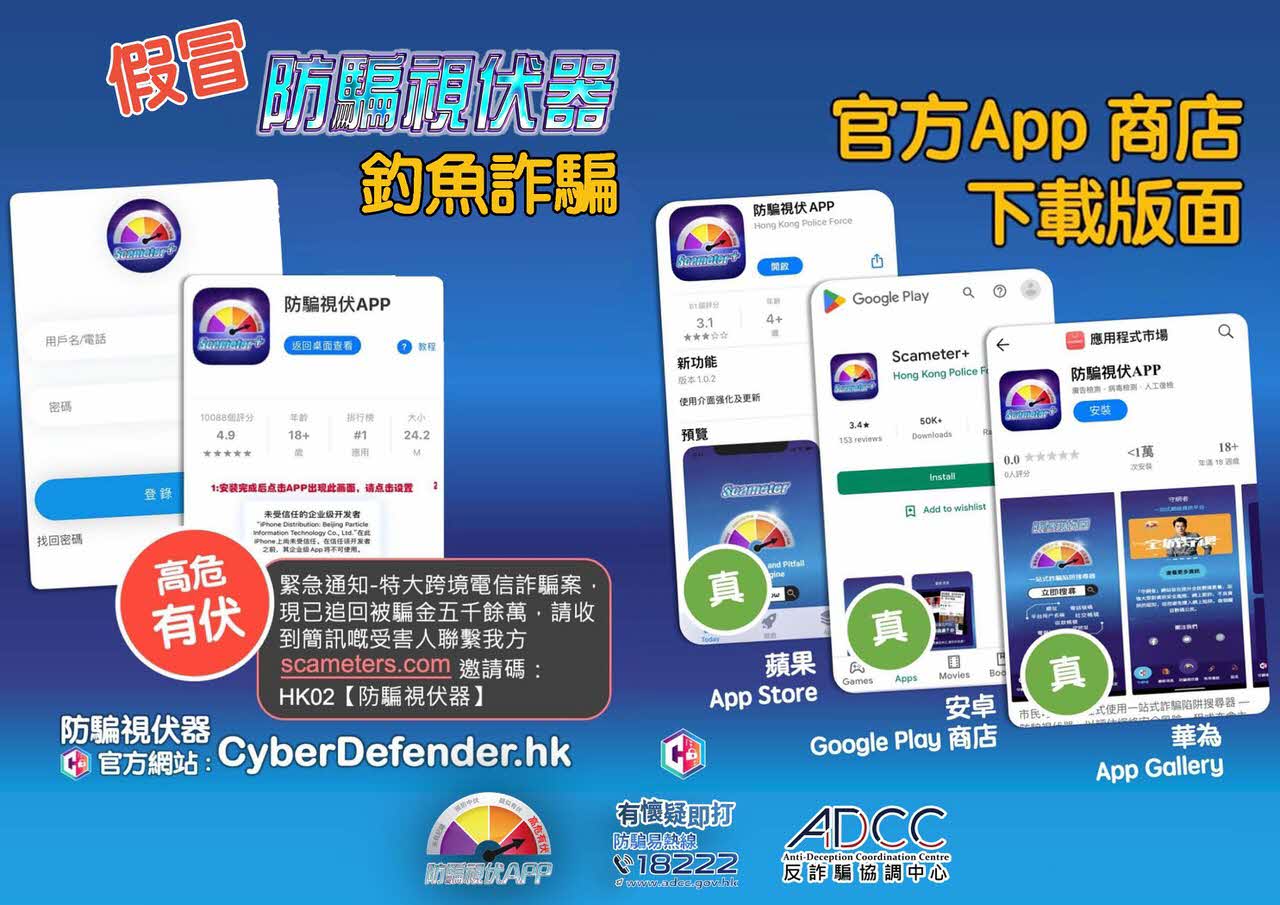
Recently, there are scammers sending phishing SMS messages to the public and claiming that an amount of fraudulent funds worth more than HK$50 million have been recovered. The recipients are tricked into clicking on a link that leads to a phishing website. They will then be asked to install a bogus version of the anti-scam app “Scameter+” and input their mobile phone number and password.
Please note that the app “Scameter+” does not collect users’ personal information or require login. As soon as the recipients install the app and set up an account, the scammers might pose as officials from the mainland and ask them to deposit money into designated accounts as handling charge to retrieve the money lost.
There is no individual website for “Scameter”. You can use it for free on the homepage of CyberDefender (https://cyberdefender.hk/en-us/). You can also download the app by entering “防騙視伏App” or “Scameter+” from the official app stores.
To know more, visit https://cyberdefender.hk/en-us/scameter/
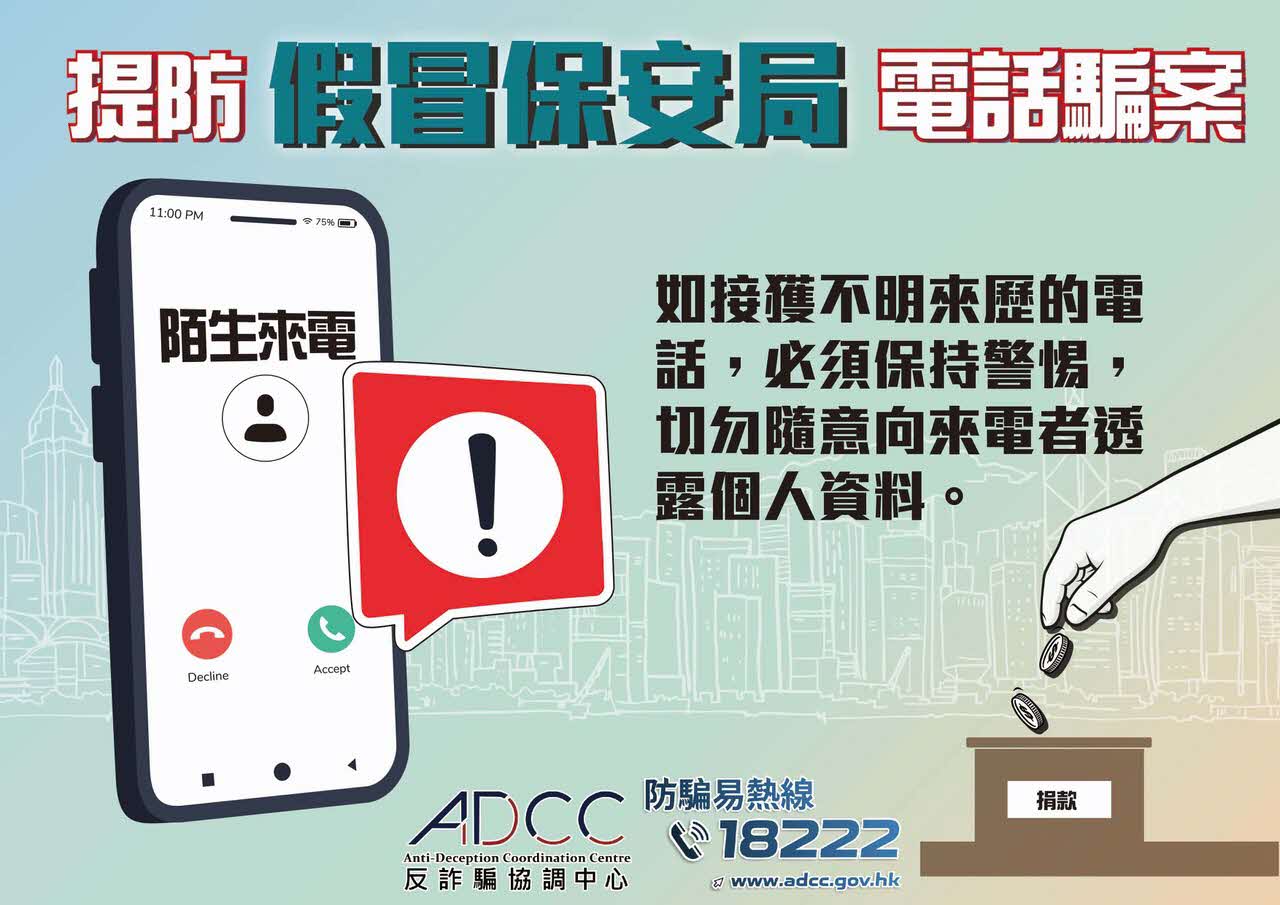
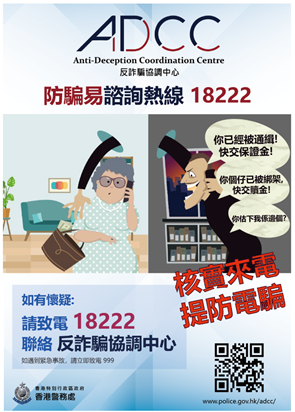
Recently, members of the public have received scam calls with 8-digit local phone number, purporting to be made from the Security Bureau. Posing as the Bureau’s staff, the caller claimed that the recipients had published messages containing photos and videos of Russo-Ukrainian War as well as appeals to donate money on social media platforms with telephone numbers registered in the Mainland, suspected of having violated Mainland laws. The scammers who speak fluent Putonghua then asked the recipients to provide their personal information or proceed to the Security Bureau office to verify their identity in person. Some scammers were able to tell the recipients’ name during the calls.
Our Advice
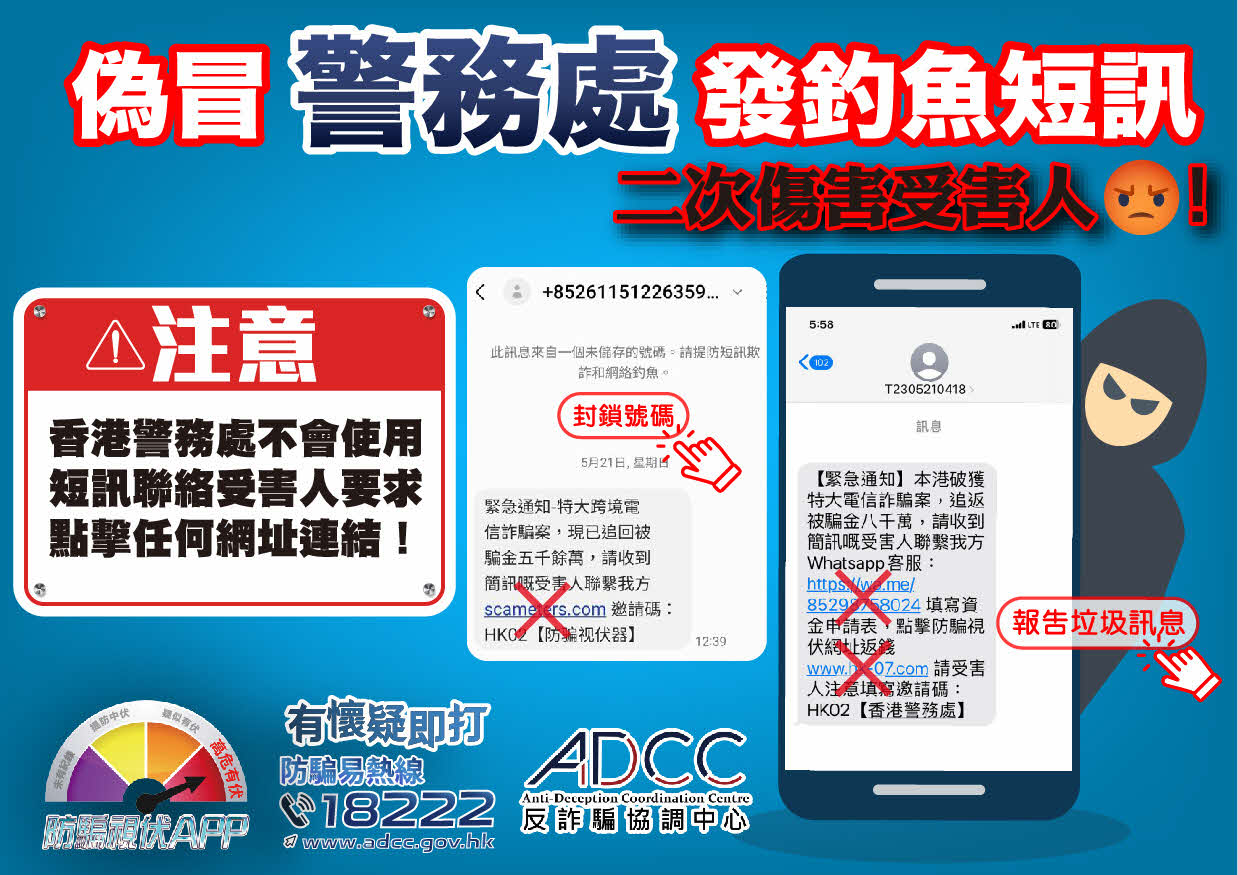
Recently, scammers impersonating Hong Kong Police Force sent fraudulent phishing SMS messages to the public, claiming that deception cases have been detected and an amount of defrauded money worth HK$80 million has been recovered. The recipients are tricked into clicking on the embedded malicious hyperlink which directs them to a fraudulent website.
As the recipients enter the fraudulent website, the scammers might ask them to input personal or bank account details, or intrude their mobile operating system to steal important data through malware.
Please note that Hong Kong Police Force will not ask members of the public to click on any URL links through SMS messages.
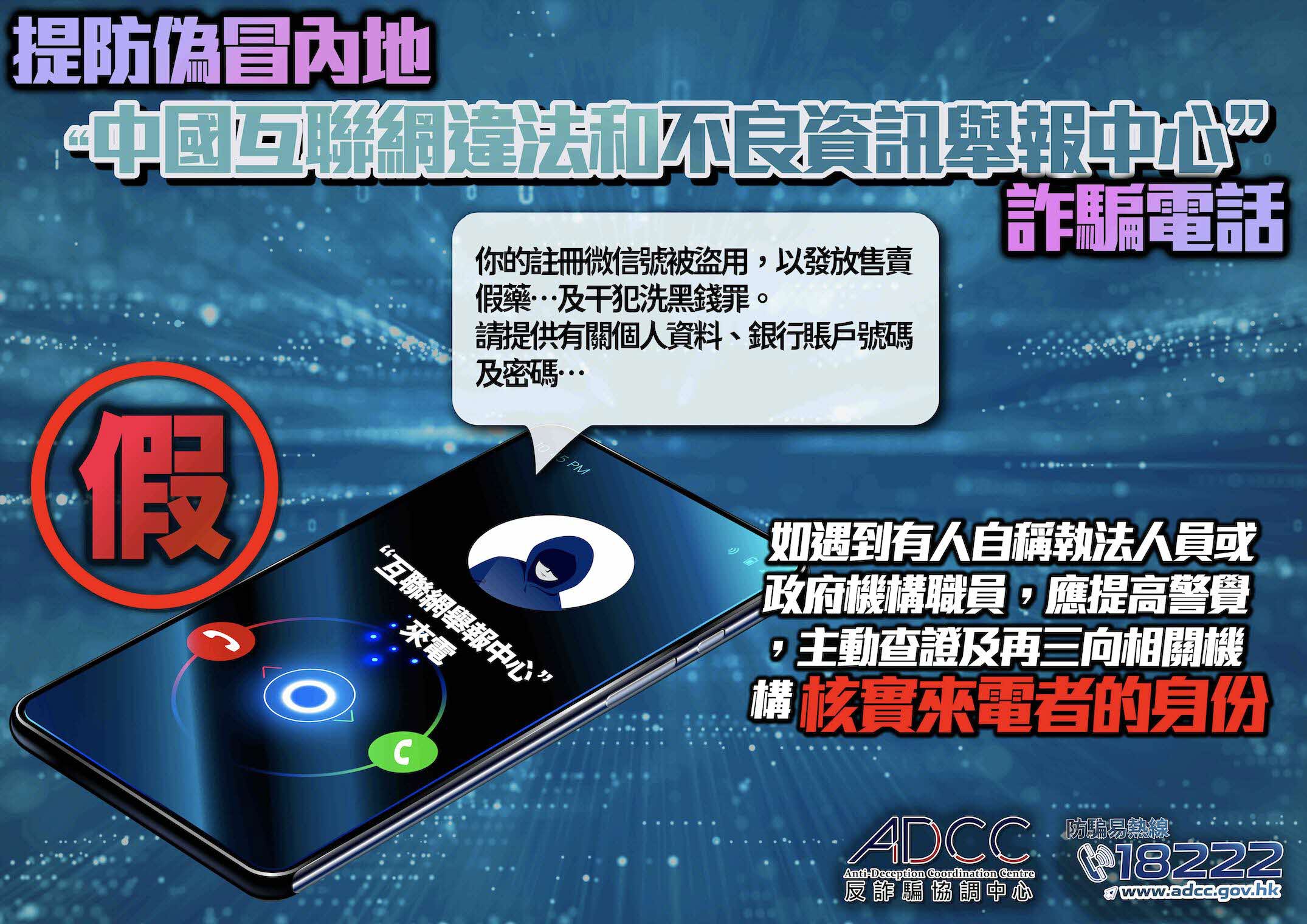
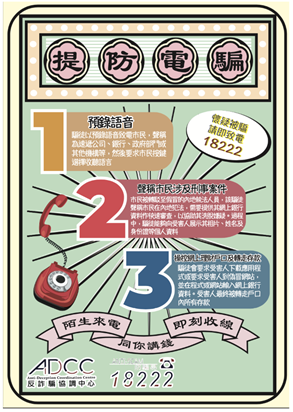
Recently, members of the public have reported to the Police about receiving scam calls made in the form of pre-recorded message or by a real person. Posing as staff of the China Internet Illegal Information Reporting Centre (CIIRC), the scammers spoke fluent Putonghua or Cantonese and claimed that the recipients’ identity had been stolen for registration of WeChat accounts to publish messages selling counterfeit medicines and luring people to engage in fraudulent events in Southeast Asian countries. The scammers would also ask the recipients to report to the Mainland law enforcement agencies for clarification and then forward the call to another scammer impersonating Mainland law enforcement officer, who alleged that the recipients had committed money laundering offences and requested their personal information, bank account number and password. They were even asked to remit money as guarantee or handling charges.
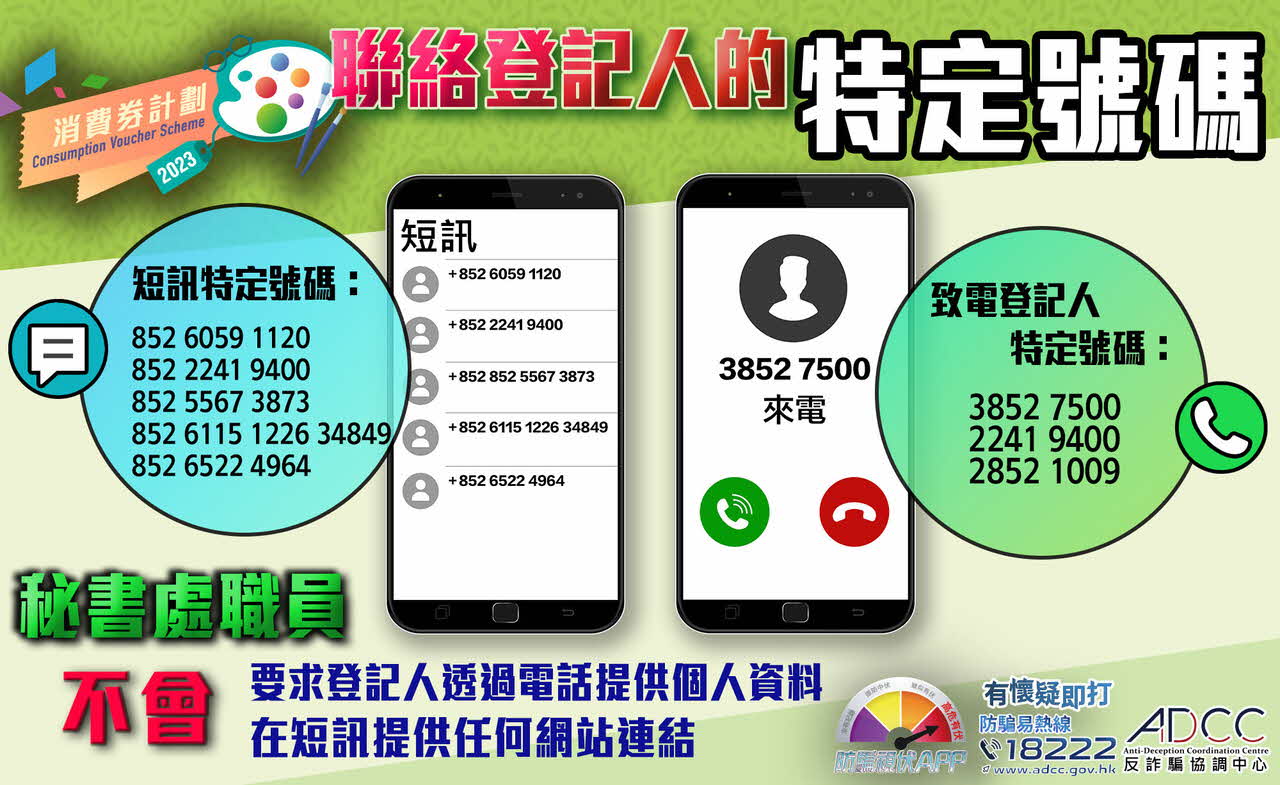
Recently, members of the public have received scam calls with 8-digit local phone number, purporting to be made from the Consumption Voucher Scheme (CVS) Secretariat or contractors. The caller claimed that the recipients were disqualified from 2023 CVS 2nd Instalment and asked for their personal information.
The registration for 2023 CVS 2nd Instalment closed on Tuesday (27 June). The Government will conduct eligibility check for all registrants. In the course of checking, the CVS Secretariat and its contractors will perform verification and contact registrants. The public are reminded to pay particular attention to the following:
(I)Calling the registrants
(II)Sending SMS to the registrants
All registrants will be notified of their checking results by SMS messages issued through the specified telephone number (852 6059 1120). Members of the public can also enquire about their checking results through the interactive voice response system of hotline 18 5000.
For the list of designated telephone numbers for contacting registrants, please visit: https://www.consumptionvoucher.gov.hk/en/information_list.html
Hackers send phishing emails or text messages impersonating organisations such as the government, banks, online payment service providers, online retailers or business partners, with links or QR codes directing to phishing websites which look like the genuine websites of relevant organisations, tricking the recipients into inputting login passwords, personal information, credit card details, etc. Hackers may also attach links, QR codes or files in the messages, if the recipients click on the links or open attachments indiscriminately, their devices may be infected by malware.
DBS Bank (Hong Kong) Limited
20 Sept 2023
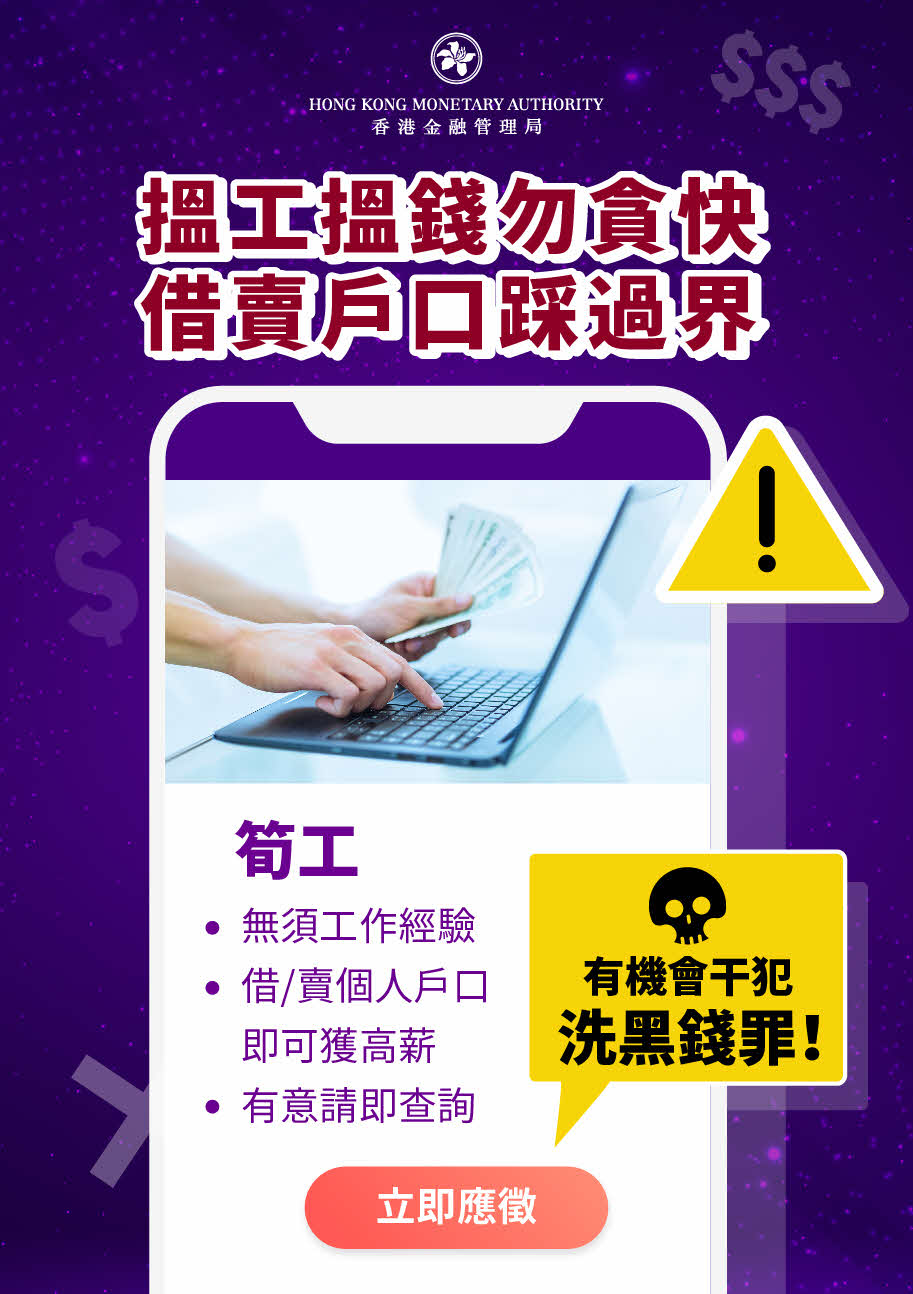
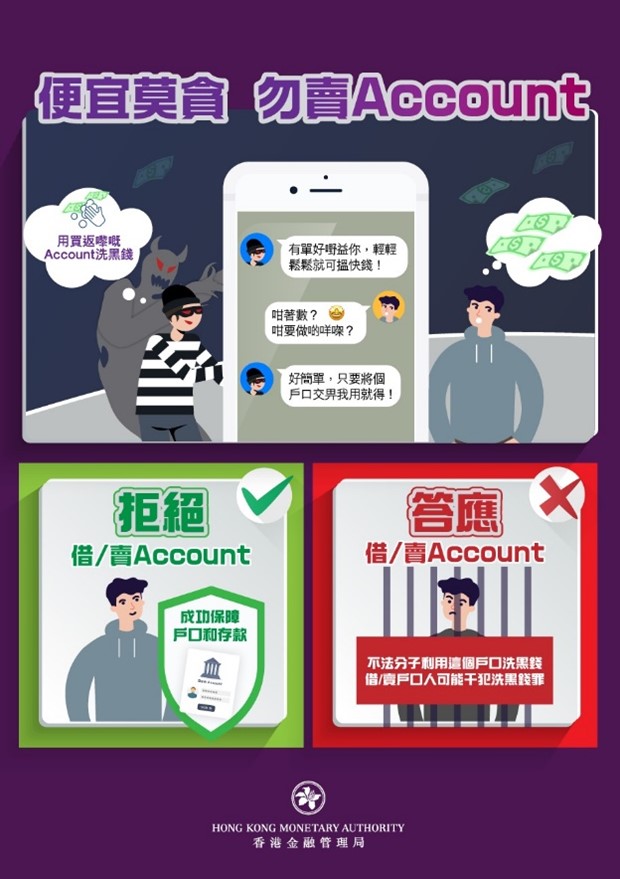
Don't be tempted by quick money, don’t lend your account to anyone to launder money
10 August 2023
Dear Valued Customer,
DBS Bank (Hong Kong) Limited (the “Bank”) would like to remind customers “Don't be tempted by quick money. Don't sell your account.”. To protect your own interests, please read the following information:
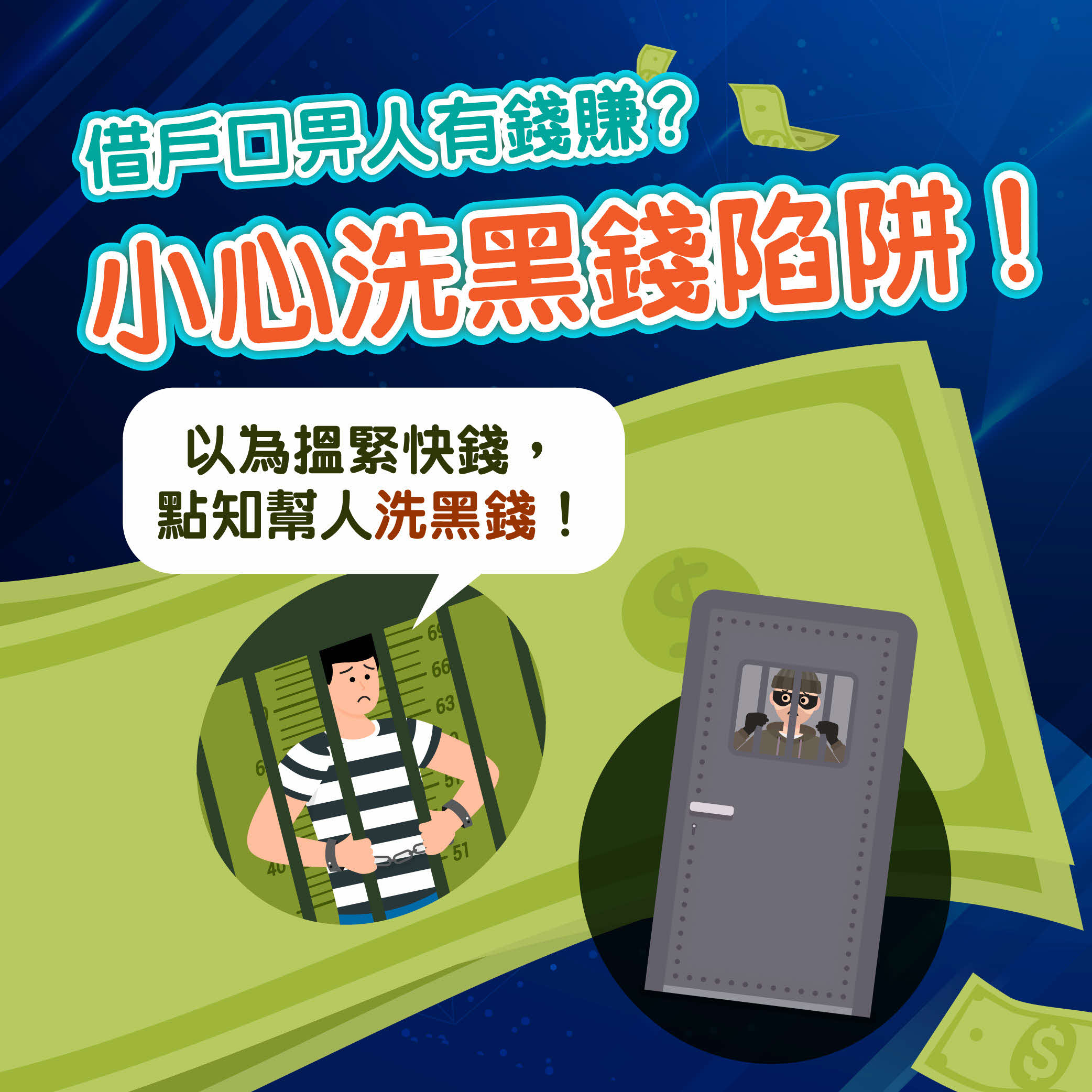
Through telemarketing or social media platforms, criminal syndicates would offer the benefit of making quick money and lure the public into selling or lending their bank accounts, or use their personal credentials to open accounts. The syndicate will then use these “stooge accounts” to receive/launder fraudulent payments or other crime proceeds. Customers are advised not to sell or lend their bank accounts to others as these might be abused for unlawful purpose and customers may expose themselves to the risk of committing money laundering offences of which the maximum penalty is imprisonment for 14 years and a fine of HKD 5 million.
For more information, please visit the Facebook and Instagram message of the HKMA posted on 25 July 2022 and click here for the publicity materials from the Authority.
10 August 2022
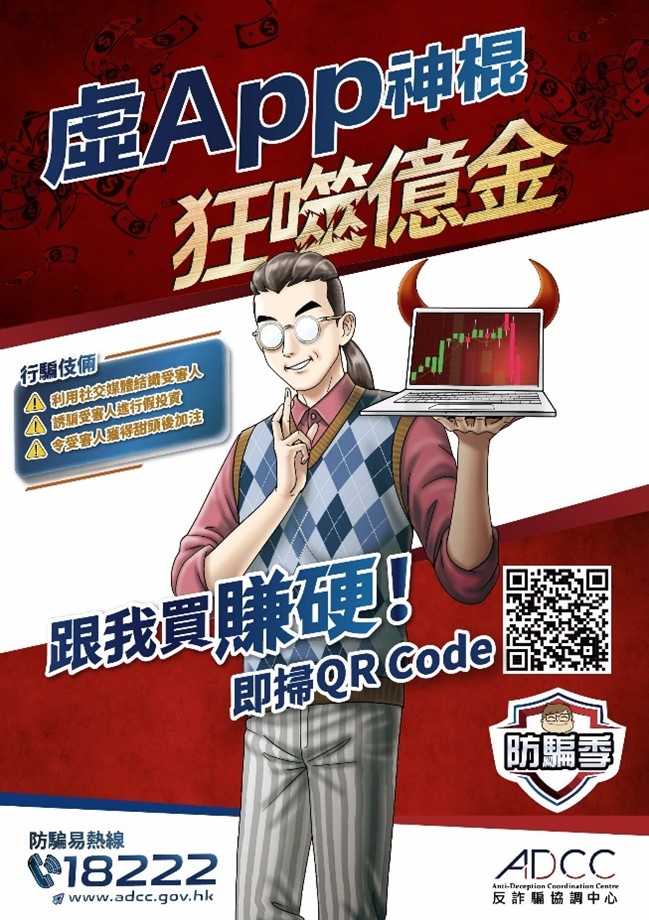
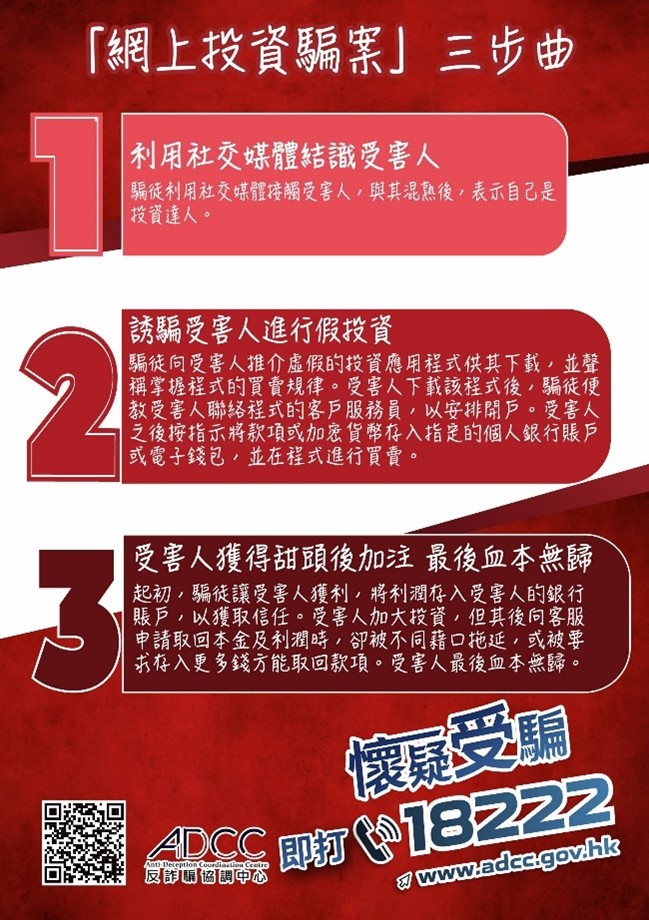
DBS Bank (Hong Kong) Limited (the “Bank”) would like to remind customers on the Internet Investment Fraud trend and their tactics. To protect your own interests, please refer to the following information:
For more information on the modus operandi, please click here (Chinese version only) or visit https://cyberdefender.hk/en-us/investment_fraud/ for the publicity materials from the Anti-Deception Coordination Centre (“ADCC”).
DBS Bank (Hong Kong) Limited (the “Bank”) would like to remind customers on “Anti-Telephone Deception”. To protect your own interests, please read the following information:
For more information, please visit to following webpage (Chinese version only) for the publicity materials from the Anti-Deception Coordination Centre.
https://www.adcc.gov.hk/en-hk/video-detail/video-1444920533647949825.htmlhttps://www.adcc.gov.hk/en-hk/video-detail/video-1444920533668921346.htmlhttps://www.adcc.gov.hk/en-hk/video-detail/video-1444920533907996674.html
18 January 2022
DBS Bank (Hong Kong) Limited (the “Bank”) would like to remind customers “Don’t Lend/ Sell Your Account. Beware of money laundering traps.”. To protect your own interests, please read the following information:
Through telemarketing or social media platforms, criminal syndicates would offer the benefit of making quick money and lure the public into selling or lending their bank accounts, or use their personal credentials to open accounts. The syndicate will then use these “stooge accounts” to receive/launder fraudulent payments or other crime proceeds.
Customers are advised not to sell or lend their bank accounts to others as these might be abused for unlawful purpose and customers may expose themselves to the risk of committing money laundering offences of which the maximum penalty is imprisonment for 14 years and a fine of HKD 5 million.
For more information, please press here (Chinese version only) to read the Facebook message of the Hong Kong Monetary Authority posted on 15 Dec 2021 and press here for the publicity materials from the Hong Kong Monetary Authority.
3 January 2022
DBS Bank (Hong Kong) Limited (the “Bank”) would like to remind customers “Don't be tempted by quick money. Don't lend your bank account to anyone to launder money.”. To protect your own interests, please read the following information:
Through telemarketing or social media platforms, criminal syndicates would offer the benefit of making quick money and lure the public into selling or lending their bank accounts, or use their personal credentials to open bank accounts. The syndicate will then use these “stooge accounts” to receive and launder fraudulent payments or other crime proceeds.
Customers are advised not to sell or lend their bank accounts/ personal credential to others as these might be abused for unlawful purpose. Otherwise, customers may expose themselves to the risk of committing the offence of money laundering of which the maximum penalty is a fine of HKD 5 million and imprisonment for 14 years.
For more information, please press here (Chinese version only) to read the Facebook message of the Hong Kong Monetary Authority posted on 13 Aug 2021.
13 December 2021