

- Airlines weathered 2Q26 better than feared, with resilient load factors across regions suggesting limited demand destruction despite sharp fare increases and elevated fuel costs
- US airlines led on pricing, while APAC benefited from transit and cargotailwinds, as Europe remained constrained by intense competition and weaker fare momentum
- We prefer US pricing power and APAC’s transit and cargo exposure, supported by further fuel-cost recapture, rerouted traffic and sustained AI-related freight demand
Related insights
- Singapore Equity Picks19 Aug 2026
- Research Library19 Aug 2026
- Impact of Middle East risks and bond sell-off19 Aug 2026

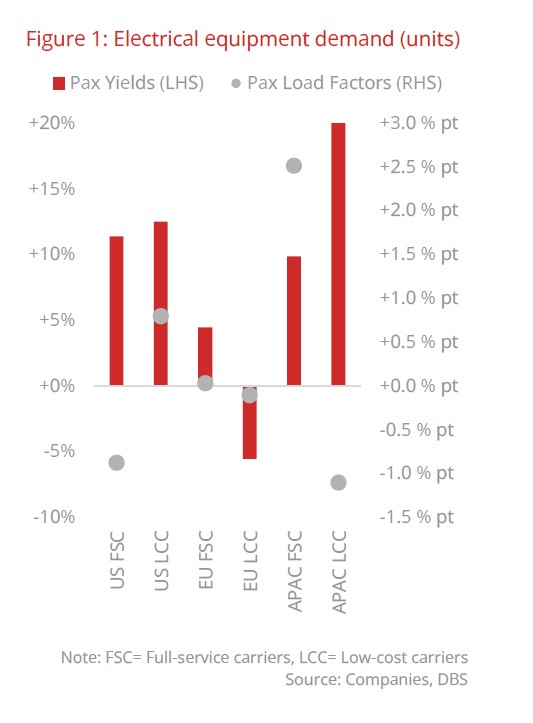
Airlines navigated a highly volatile 2Q26 better than feared, with passengers showing limited resistance to higher fares. The June MOU initially raised hopes of de-escalation before tensions re-escalated, although recent diplomatic progress has once again improved prospects for a more durable ceasefire or interim agreement. Geopolitical uncertainty remains, but jet fuel prices have fallen materially from their conflict-driven peaks, easing immediate cost pressure. More importantly, airlines across North America, Europe, and APAC have generally raised fares without triggering meaningful demand destruction. North America saw the strongest fare increases, APAC network carriers also achieved firmer pricing, while Europe remained more constrained by competition. Load factors have nevertheless held up across all three regions, reinforcing our view that underlying travel demand remains healthy and airlines still have scope to pass through elevated costs.
2Q26 performance diverged sharply, with US airlines showing the strongest pricing power while cargo-heavy APAC carriers benefitted from additional freight tailwinds. North American network carriers recorded high single-digit to low double-digit passenger yield growth, supported by favourable supply-demand dynamics and tighter capacity following Spirit Airlines’ exit, allowing them to recapture around 50-60% of the incremental fuel headwind. Europe was more challenging, as heavier fuel hedging reduced the urgency for immediate fare increases while intense competition weighed on pricing, particularly among LCCs. European network carriers fared better, although recovery varied materially, with Air France-KLM recapturing around 85% of incremental fuel costs versus roughly 60% at IAG and Lufthansa. In APAC, network carriers with greater cargo exposure outperformed as disruptions in the Middle East redirected passenger traffic and constrained competing freight capacity, while robust AI-related shipments supported air freight rates.
We prefer US pricing power and APAC transit and cargo exposure in the near term. The US offers the clearest path to further margin recovery as additional repricing flows through the booking curve, with some carriers targeting full fuel-cost recovery by year-end. European carriers remain less upbeat, with guidance generally implying only partial recovery as competitive intensity limits further fare increases. In APAC, we expect the transit benefit to persist even if geopolitical tensions ease, as travellers, particularly premium passengers, may take time to regain confidence in Middle Eastern routings. Cargo provides an additional tailwind, with sustained AI infrastructure investment supporting high-value air freight demand. The key sector-wide risk remains another sharp rise in jet fuel prices, especially as current recovery expectations were formed against more benign forward curves. Overall, we continue to see the best risk-reward in US pricing power and APAC transit and cargo exposure.
Download the PDF to read the full report which includes coverage on Credit, FX, Rates, and Thematics.
Topic
The information published by DBS Bank Ltd. (company registration no.: 196800306E) (“DBS”) is for information only. It is based on information or opinions obtained from sources believed to be reliable (but which have not been independently verified by DBS, its related companies and affiliates (“DBS Group”)) and to the maximum extent permitted by law, DBS Group does not make any representation or warranty (express or implied) as to its accuracy, completeness, timeliness or correctness for any particular purpose. Opinions and estimates are subject to change without notice. The publication and distribution of the information does not constitute nor does it imply any form of endorsement by DBS Group of any person, entity, services or products described or appearing in the information. Any past performance, projection, forecast or simulation of results is not necessarily indicative of the future or likely performance of any investment or securities. Foreign exchange transactions involve risks. You should note that fluctuations in foreign exchange rates may result in losses. You may wish to seek your own independent financial, tax, or legal advice or make such independent investigations as you consider necessary or appropriate.
The information published is not and does not constitute or form part of any offer, recommendation, invitation or solicitation to subscribe to or to enter into any transaction; nor is it calculated to invite, nor does it permit the making of offers to the public to subscribe to or enter into any transaction in any jurisdiction or country in which such offer, recommendation, invitation or solicitation is not authorised or to any person to whom it is unlawful to make such offer, recommendation, invitation or solicitation or where such offer, recommendation, invitation or solicitation would be contrary to law or regulation or which would subject DBS Group to any registration requirement within such jurisdiction or country, and should not be viewed as such. Without prejudice to the generality of the foregoing, the information, services or products described or appearing in the information are not specifically intended for or specifically targeted at the public in any specific jurisdiction.
The information is the property of DBS and is protected by applicable intellectual property laws. No reproduction, transmission, sale, distribution, publication, broadcast, circulation, modification, dissemination, or commercial exploitation such information in any manner (including electronic, print or other media now known or hereafter developed) is permitted.
DBS Group and its respective directors, officers and/or employees may have positions or other interests in, and may effect transactions in securities mentioned and may also perform or seek to perform broking, investment banking and other banking or financial services to any persons or entities mentioned.
To the maximum extent permitted by law, DBS Group accepts no liability for any losses or damages (including direct, special, indirect, consequential, incidental or loss of profits) of any kind arising from or in connection with any reliance and/or use of the information (including any error, omission or misstatement, negligent or otherwise) or further communication, even if DBS Group has been advised of the possibility thereof.
The information is not intended for distribution to, or use by, any person or entity in any jurisdiction or country where such distribution or use would be contrary to law or regulation. The information is distributed (a) in Singapore, by DBS Bank Ltd.; (b) in China, by DBS Bank (China) Ltd; (c) in Hong Kong, by DBS Bank (Hong Kong) Limited; (d) in Taiwan, by DBS Bank (Taiwan) Ltd; (e) in Indonesia, by PT DBS Indonesia; and (f) in India, by DBS Bank Ltd, Mumbai Branch.
Related insights
- Singapore Equity Picks19 Aug 2026
- Research Library19 Aug 2026
- Impact of Middle East risks and bond sell-off19 Aug 2026
Related insights
- Singapore Equity Picks19 Aug 2026
- Research Library19 Aug 2026
- Impact of Middle East risks and bond sell-off19 Aug 2026