

- Yen weakness and rising JGB yields are nolonger isolated domestic issues; they posebroader risks to global duration markets,especially long-dated USD bonds
- Japan’s high debt burden limits howaggressively the BOJ can tighten policy,leaving inflation expectations and long-endJGB yields vulnerable
- Japan’s creditor-nation status and large netinternational investment position gives itample foreign assets to defend the yen, butany capital repatriation could pressure USTreasuries via reduced Japanese demand
- We believe the US has intervened in the yento reduce risk of such capital flight. Thissuggests potential “lines in the sand” for USyields, but debt sustainability and inflationremain key headwinds; we prefer 5–7Y duration and A/BBB credit
Related insights

Chaos theory. Over the last few weeks, Japan and the United States launched a rare joint currency intervention—the first major coordinated G7 action since 2011—spending nearly USD59bn to prop up the JPY after the currency hit 40-year lows. While seemingly unrelated, we believe this has material implications for the fixed income landscape. Now in case one thinks that we are greatly exaggerating causality, a little scrutiny reveals that such coordinated currency interventions across the Pacific are in great part to do with both gargantuan UST and JGB bond markets becoming unsustainably large in the face of rising inflation. As such, a butterfly flapping its wings in the FX markets can set off a tornado in the bond markets; it was perhaps best that the US caught said butterfly before their own yield curves went out of control.
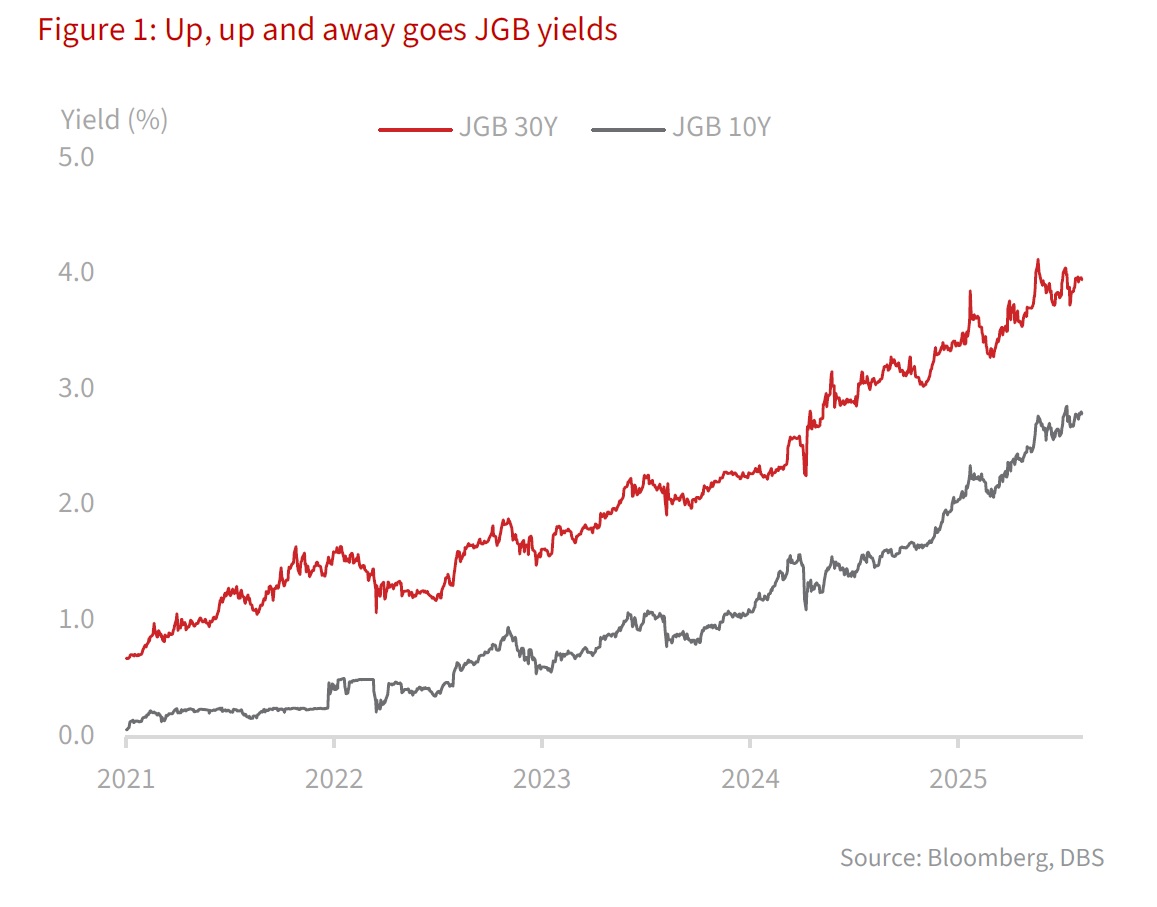
Land of the rising yields. It was more than three years ago that we addressed this risk that was quietly bubbling in the ramen broth in our CIO Perspectives (Land of the Rising Yields: Influence on Longer-dated USD Bonds, published 27 Jan 2023). Market observers would also note that JGBs have since done exactly as the title suggested, which hopefully lends credence to the thesis at the time. Back then, unlike the rest of the world, the Bank of Japan (BOJ) was running an extremely accommodative monetary policy (negative yields). Our take was that onshore yields in Japan would continue to rise as the BOJ removes accommodation in the face of sticky inflation, causing a risk to long duration bonds across the developed market bond universe due to the permeability of capital flows. Seeing as 30Y US treasuries have since risen from c.3.62% at the time of reporting to c.5.25% today (with JGBs faring even worse), it would have benefitted fixed income portfolios to have heeded that risk.
Download the PDF to read the full report which includes coverage on Credit, FX, Rates, and Thematics.
Topic
The information published by DBS Bank Ltd. (company registration no.: 196800306E) (“DBS”) is for information only. It is based on information or opinions obtained from sources believed to be reliable (but which have not been independently verified by DBS, its related companies and affiliates (“DBS Group”)) and to the maximum extent permitted by law, DBS Group does not make any representation or warranty (express or implied) as to its accuracy, completeness, timeliness or correctness for any particular purpose. Opinions and estimates are subject to change without notice. The publication and distribution of the information does not constitute nor does it imply any form of endorsement by DBS Group of any person, entity, services or products described or appearing in the information. Any past performance, projection, forecast or simulation of results is not necessarily indicative of the future or likely performance of any investment or securities. Foreign exchange transactions involve risks. You should note that fluctuations in foreign exchange rates may result in losses. You may wish to seek your own independent financial, tax, or legal advice or make such independent investigations as you consider necessary or appropriate.
The information published is not and does not constitute or form part of any offer, recommendation, invitation or solicitation to subscribe to or to enter into any transaction; nor is it calculated to invite, nor does it permit the making of offers to the public to subscribe to or enter into any transaction in any jurisdiction or country in which such offer, recommendation, invitation or solicitation is not authorised or to any person to whom it is unlawful to make such offer, recommendation, invitation or solicitation or where such offer, recommendation, invitation or solicitation would be contrary to law or regulation or which would subject DBS Group to any registration requirement within such jurisdiction or country, and should not be viewed as such. Without prejudice to the generality of the foregoing, the information, services or products described or appearing in the information are not specifically intended for or specifically targeted at the public in any specific jurisdiction.
The information is the property of DBS and is protected by applicable intellectual property laws. No reproduction, transmission, sale, distribution, publication, broadcast, circulation, modification, dissemination, or commercial exploitation such information in any manner (including electronic, print or other media now known or hereafter developed) is permitted.
DBS Group and its respective directors, officers and/or employees may have positions or other interests in, and may effect transactions in securities mentioned and may also perform or seek to perform broking, investment banking and other banking or financial services to any persons or entities mentioned.
To the maximum extent permitted by law, DBS Group accepts no liability for any losses or damages (including direct, special, indirect, consequential, incidental or loss of profits) of any kind arising from or in connection with any reliance and/or use of the information (including any error, omission or misstatement, negligent or otherwise) or further communication, even if DBS Group has been advised of the possibility thereof.
The information is not intended for distribution to, or use by, any person or entity in any jurisdiction or country where such distribution or use would be contrary to law or regulation. The information is distributed (a) in Singapore, by DBS Bank Ltd.; (b) in China, by DBS Bank (China) Ltd; (c) in Hong Kong, by DBS Bank (Hong Kong) Limited; (d) in Taiwan, by DBS Bank (Taiwan) Ltd; (e) in Indonesia, by PT DBS Indonesia; and (f) in India, by DBS Bank Ltd, Mumbai Branch.