

- Global: Middle East conflict and AI-driven demand have lifted inflation, but the shock looks manageable; expect divergent policy response, with Korea/Taiwan tightening and India pausing
- Singapore: We expect no change to SGD NEER policy after MAS April tightening; inflation is likely to rise from July, reflecting the lagged effects of energy shock, but a sharp acceleration is unlikely
- South Korea: We revised up our 2026 GDP growth forecast to 3.5% from 2.6%, and our 2027 forecast to 2.4% from 2.0% following stronger than expected 2Q26; we expect BOK to deliver an additional 50 bps of rate hikes over the remainder of the year, following the 25 bps increase in July
- Indonesia: Following a BI’s unexpected pause in July, we maintain our call for one final rate hike in 2H26, premised on a market repricing toward higher US interest rates
Related insights
- Policy Expectations on Watch21 Aug 2026
- FX Tactical Ideas: Increasing Pressure on the USD21 Aug 2026
- Research Library21 Aug 2026

Global: Varying calculations for central banks. Conflicts in the Middle East and the AI cycle have driven up prices this year. In its July update, the IMF projects that global inflation will rise from 4.1% in 2025 to 4.7% in 2026. These projections are less dire than initially feared when the conflict broke out. This was going to be a year of higher inflation in any case. The IMF, back in October of last year had projected global inflation to rise by 30 bps in 2026. Pass-through from tariffs, rising prices of electronics on the back of the AI cycle, and resilient demand were expected to be key contributors to the modest increase in inflation around the world. Adding war-related considerations on top of those factors, a further 30 bps increase in global inflation projection (to 4.7%) is not extreme by any means, in our view.
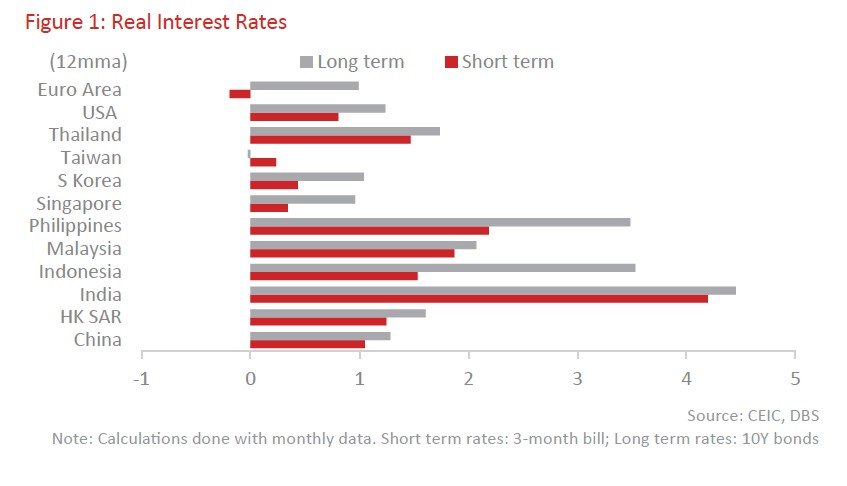
Granted, there will be consequences for economies and individuals at the lower end of the income spectrum. Monetary policy is already being recalibrated, exchange rates have been adjusting, but overall, compared to the inflation shock of 2022/23, this episode comes across to us as manageable. The world is bifurcated between those with heavy energy dependence and those fortunate enough to have domestic endowments of energy. Additionally, a line can be drawn between those benefitting from the AI cycle’s demand surge for hardware and those not in that manufacturing ecosystem. As we consider market and policy outlook for the rest of the year, these issues come to the fore. Take South Korea and Taiwan, both undergoing historic surges in export demand (rising presently at respective y/y rates of 70%+ and 40%+) and asset price booms. The fact that their inflation forecasts for 2026 are up only modestly should not hold back monetary authorities from tightening policy. Indeed, the time to get in the way of overheating is right now. On the other end of the spectrum is India, with considerable exposure to the commodity price surge but still characterised by within-target inflation, firmly positive real interest rates, and measures being taken to mobilise capital flows. We think this gives the RBI plenty of space to maintain policy pause. These cases point out the spectrum of monetary policy compulsions. Central banking is not one-size-fits all.
Meanwhile, the Japan Cabinet approved the “Basic Policy on Economic and Fiscal Management and Reform” on 21 Jul, establishing the Takaichi government’s top-level economic policy framework centered on a pro-growth strategy. The guideline incorporates the JPY370tn public-private investment plan through FY2040, targeting a broad range of strategic sectors, including AI, semiconductors, quantum technology, defense, aerospace, biotechnology, and advanced medicine. It sets an ambitious goal of raising nominal GDP to JPY1,100tn by FY2040, implying average annual nominal GDP growth of more than 3% and real GDP growth of above 1% over the period.
Download the PDF to read the full report which includes coverage on Credit, FX, Rates, and Thematics.
Topic
The information published by DBS Bank Ltd. (company registration no.: 196800306E) (“DBS”) is for information only. It is based on information or opinions obtained from sources believed to be reliable (but which have not been independently verified by DBS, its related companies and affiliates (“DBS Group”)) and to the maximum extent permitted by law, DBS Group does not make any representation or warranty (express or implied) as to its accuracy, completeness, timeliness or correctness for any particular purpose. Opinions and estimates are subject to change without notice. The publication and distribution of the information does not constitute nor does it imply any form of endorsement by DBS Group of any person, entity, services or products described or appearing in the information. Any past performance, projection, forecast or simulation of results is not necessarily indicative of the future or likely performance of any investment or securities. Foreign exchange transactions involve risks. You should note that fluctuations in foreign exchange rates may result in losses. You may wish to seek your own independent financial, tax, or legal advice or make such independent investigations as you consider necessary or appropriate.
The information published is not and does not constitute or form part of any offer, recommendation, invitation or solicitation to subscribe to or to enter into any transaction; nor is it calculated to invite, nor does it permit the making of offers to the public to subscribe to or enter into any transaction in any jurisdiction or country in which such offer, recommendation, invitation or solicitation is not authorised or to any person to whom it is unlawful to make such offer, recommendation, invitation or solicitation or where such offer, recommendation, invitation or solicitation would be contrary to law or regulation or which would subject DBS Group to any registration requirement within such jurisdiction or country, and should not be viewed as such. Without prejudice to the generality of the foregoing, the information, services or products described or appearing in the information are not specifically intended for or specifically targeted at the public in any specific jurisdiction.
The information is the property of DBS and is protected by applicable intellectual property laws. No reproduction, transmission, sale, distribution, publication, broadcast, circulation, modification, dissemination, or commercial exploitation such information in any manner (including electronic, print or other media now known or hereafter developed) is permitted.
DBS Group and its respective directors, officers and/or employees may have positions or other interests in, and may effect transactions in securities mentioned and may also perform or seek to perform broking, investment banking and other banking or financial services to any persons or entities mentioned.
To the maximum extent permitted by law, DBS Group accepts no liability for any losses or damages (including direct, special, indirect, consequential, incidental or loss of profits) of any kind arising from or in connection with any reliance and/or use of the information (including any error, omission or misstatement, negligent or otherwise) or further communication, even if DBS Group has been advised of the possibility thereof.
The information is not intended for distribution to, or use by, any person or entity in any jurisdiction or country where such distribution or use would be contrary to law or regulation. The information is distributed (a) in Singapore, by DBS Bank Ltd.; (b) in China, by DBS Bank (China) Ltd; (c) in Hong Kong, by DBS Bank (Hong Kong) Limited; (d) in Taiwan, by DBS Bank (Taiwan) Ltd; (e) in Indonesia, by PT DBS Indonesia; and (f) in India, by DBS Bank Ltd, Mumbai Branch.
Related insights
- Policy Expectations on Watch21 Aug 2026
- FX Tactical Ideas: Increasing Pressure on the USD21 Aug 2026
- Research Library21 Aug 2026
Related insights
- Policy Expectations on Watch21 Aug 2026
- FX Tactical Ideas: Increasing Pressure on the USD21 Aug 2026
- Research Library21 Aug 2026